
Blog
Hosting at Home: A Complete Guide to Warm, Beautiful Dining Experiences

Quick Answer
Hosting at home beautifully doesn’t require a large space or expensive decor. It comes down to three things: intentional serveware, cohesive colours and textures, and the mindset that everyday meals deserve care. Even a simple chai with a friend can feel special when the table is set with attention.
The art of hosting at home is no longer just about serving food.
Across modern Indian homes — in Mumbai apartments, Bangalore townhouses, and Delhi living rooms — dining is quietly evolving. It has become a way people express warmth, taste, identity, and care. And with more of us choosing intimate meals at home over restaurants, how a table looks and feels has never mattered more.
This guide covers everything: from setting a beautiful dining table on any budget, to choosing serveware that reflects your style, to the small everyday rituals that turn ordinary meals into meaningful ones.
Table of Contents
What ‘Hosting at Home’ Really Means in 2025
Hosting is no longer reserved for festive gatherings or formal dinner parties. In most Indian households today, it looks like:
- A chai-and-snacks setup on a weekday evening with a close friend
- Weekend brunch with family, laid out with a little more intention than usual
- A quiet dinner that feels special simply because the table does
- Small celebrations — a promotion, a birthday, a return from travel — marked at home
This shift matters because it changes what “good hosting” means. It’s less about perfection and more about feeling. Less about impressing, more about including. And it has created a new kind of interest in how our dining tables look — not just for guests, but for ourselves.
Table Styling Ideas for Everyday Dining at Home
You don’t need a decorator or a large budget to make your dining table feel considered. Here are the principles that actually work.
1. Work with a tonal palette, not a matching set
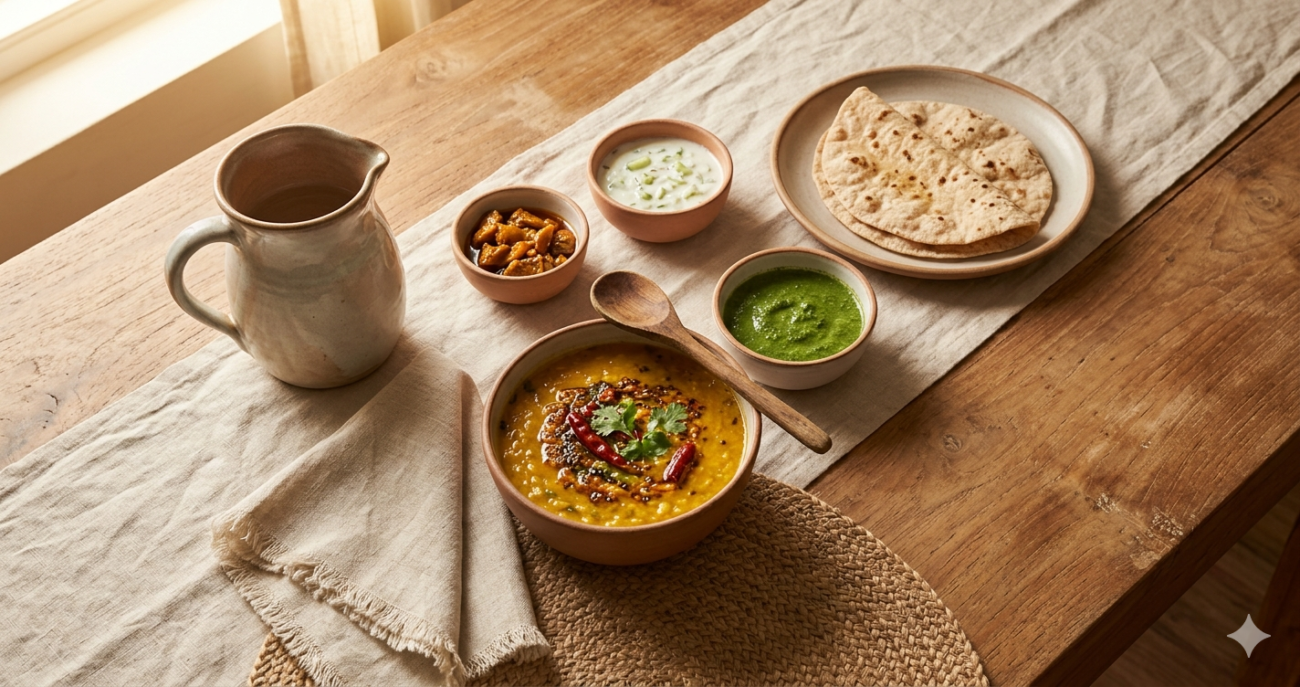
Earthy tones — clay, sand, warm white, olive, rust — work naturally together because they share warmth. You don’t need everything to match; you need everything to belong to the same mood. A terracotta bowl, a beige linen napkin, and a dark teak board will feel cohesive even though they’re different materials, colours, and textures.
2. Layer textures rather than surfaces
Flat uniformity feels sterile. Layering — a woven placemat under a ceramic plate, a small linen cloth under a serving bowl — creates depth and visual warmth without clutter. The rule of thumb: one natural material per table layer.
3. Let the food be part of the visual
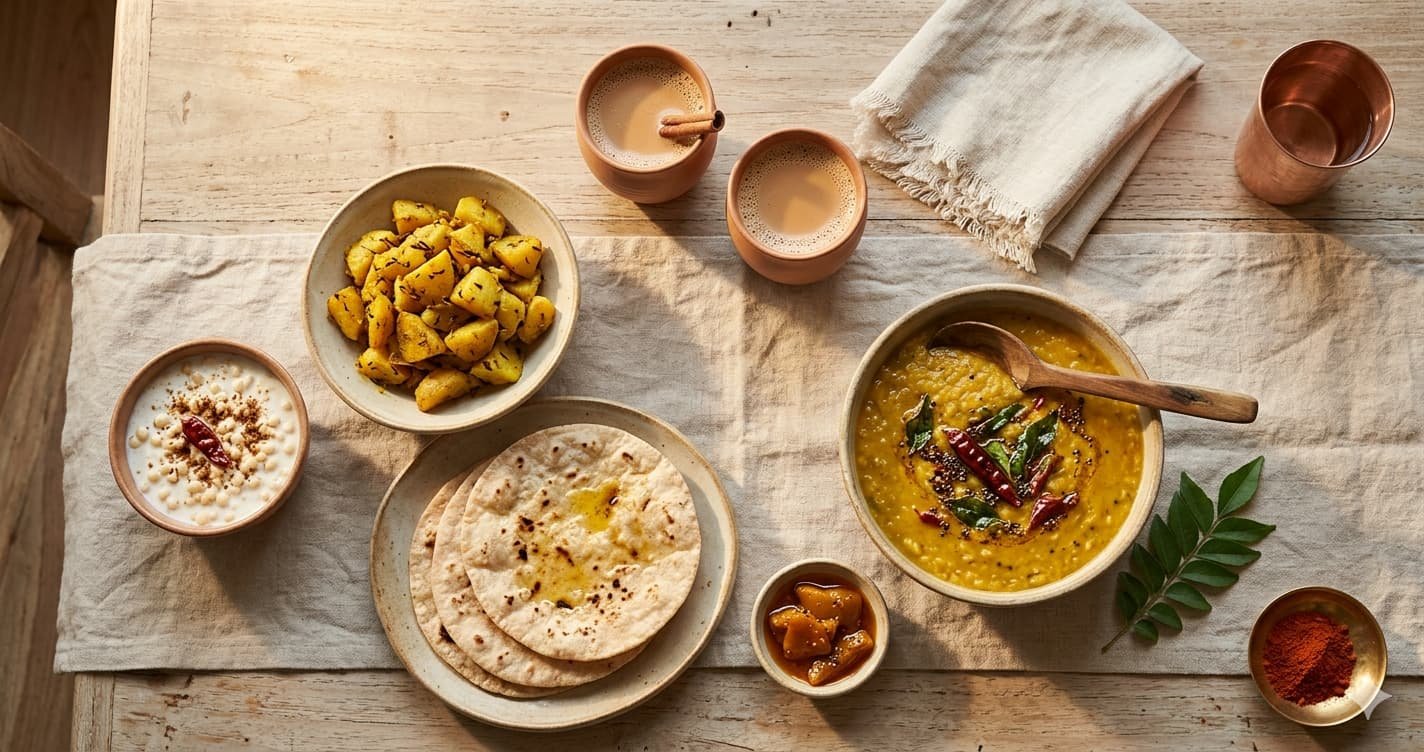
Food is already colour, texture, and design. A bowl of dal against a matte black ceramic, a bright green chutney in a small white bowl, fresh rotis stacked in an earthy basket — these need no additional styling. Choose serveware that frames food rather than competes with it.
4. Light changes everything
Natural afternoon light or warm-toned evening lamps will do more for your table than any styling choice. Avoid cool white LEDs for dining — they flatten food colours and reduce warmth. A single pendant or a cluster of tea lights can transform the mood entirely.
For a deeper look at practical table styling techniques, read our complete guide on dining table styling ideas.
How to Choose Serveware That Elevates Your Dining Table
Serveware is the most underestimated element of a beautiful dining table. Most people treat it as purely functional — plates, bowls, cups. But in practice, serveware shapes the mood of the entire meal.
The same dal can feel like a Tuesday-night dinner or a mindful, nourishing experience — the difference is often just what it’s served in.
What to look for in serveware
Weight and feel matter as much as looks. Handmade ceramics have a warmth in the hand that machine-made pieces lack. Look for matte or satin finishes over high-gloss — they photograph better, age gracefully, and feel more grounded on the table. For Indian cooking especially, consider depth: generous bowl shapes that hold curries, dals, and rice without spilling.
Why handmade ceramic serveware is different
Handmade ceramic pieces bring something specific to the table: variation. No two pieces are identical. The slight irregularity in the rim, the thumbprint-smooth interior, the glaze that breaks differently at the edge — these are not flaws. They are the marks of someone having made the thing, and they make the object feel alive in a way that factory uniformity cannot replicate.
Indian Hosting Culture: Ancient Warmth, Modern Expression
In Indian homes, hospitality is not a performance — it is an instinct. The moment a guest crosses the threshold, something activates: the kettle goes on, snacks appear, food is offered before anyone has asked. Atithi Devo Bhava — the guest is God — is not just a phrase. It is a lived reflex.
What is changing in modern Indian homes is not this instinct, but its visual expression. A generation of urban homemakers — in Bengaluru, Pune, Lucknow, Hyderabad — is asking a new kind of question: not just “what should I serve?” but “how should it look?”
The answer emerging is quieter and more considered than the maximalism of earlier decades. Fewer pieces. Better quality. Calmer tables. Serving chai in a handmade ceramic cup rather than a plastic-handled mug is not pretension — it is the same warmth, expressed with more intention.
The hosting occasions where this shift is most visible
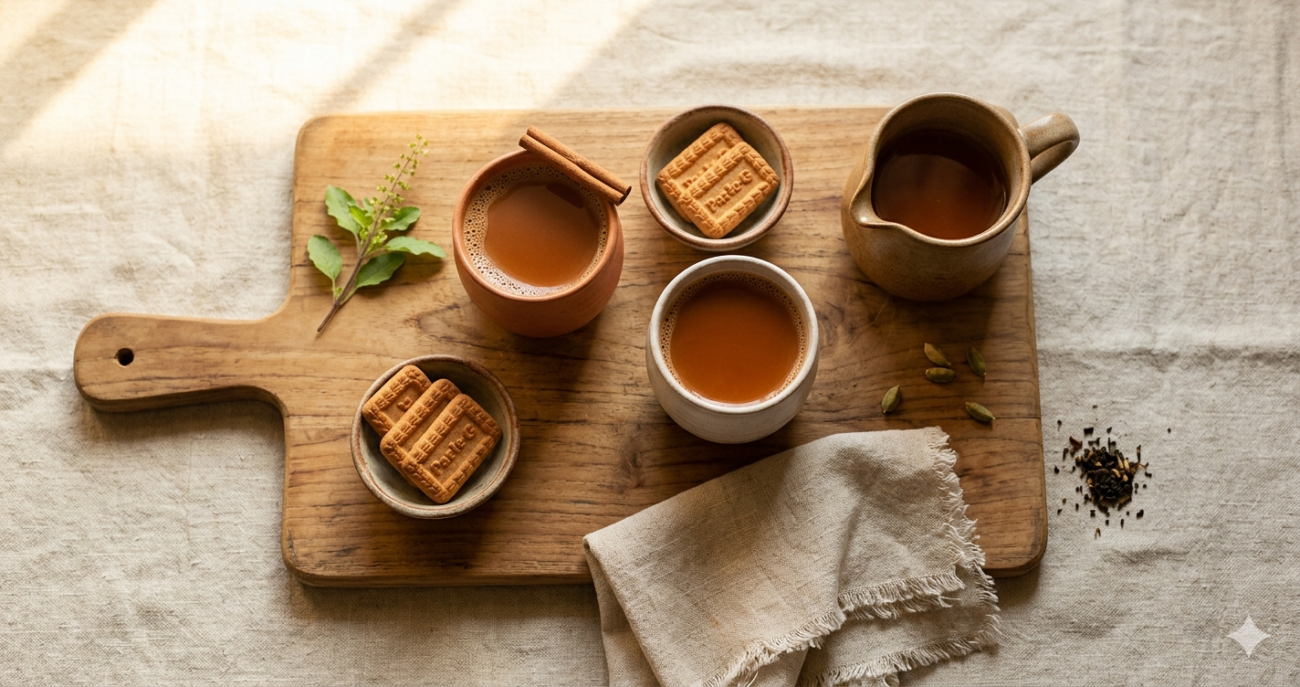
- Evening chai with neighbours — the most repeated hosting ritual in Indian homes. Serving chai beautifully is itself an art — from the right cup to the right tray setup. Read our complete guide on chai serving ideas for everyday hosting.
- Diwali and festive gatherings — where the table now competes with the decor
- Sunday family meals — increasingly treated as something worth setting a table for
- Housewarming and milestone celebrations hosted at home rather than in banquet halls
Everyday Dining Rituals: How Small Moments Shape a Home
Not every meal needs to be an event. But there is a difference between eating and dining — and the line between them is almost entirely about intention.
Small rituals that cost nothing but attention
- Setting the table before calling people to eat, rather than eating from serving vessels
- Using the same bowl every morning for breakfast — one that you actually like the feel of
- Arranging snacks in a small ceramic dish rather than serving from the packet
- Switching to warm-toned lamps for dinner, even on a Tuesday
These are not aesthetic choices for Instagram. They are small acts of care directed at the people who share your table — including yourself. And over time, they become the texture of a home: the particular way this place feels to eat in.
This is why the psychology of beautiful dining goes deeper than visuals. When a table feels intentional, people slow down. Conversations get longer. The food — the same food — tastes better. Research published in the journal Appetite confirms this, people consistently rated the same food as more enjoyable, more flavourful, and more desirable to eat when the surrounding environment had higher aesthetic value. The meal becomes a moment rather than a task.
How to Build Your Own Home Hosting Style
There is no correct way to set a table. But a personal hosting style — one that feels effortless because it reflects you — usually emerges through a few consistent choices.
A simple framework to start with
Pick one material to anchor your table — ceramic, wood, linen, or stone. Build outward from there. A ceramic-first table pairs naturally with linen napkins and wooden boards. A linen-first table pairs with simple glass and minimal pottery. Choose one, add slowly, and edit ruthlessly — less always reads as more intentional.
Notice what feels calming when you eat at someone else’s home or in a café you love. It’s almost never the most decorated table. It’s the one where every element seems to belong — where nothing is competing for attention, and where the food and the people are what you notice first.
Start there.
The Art of Hosting, Revisited
The art of hosting at home has never been about impressing anyone. It has always been about the belief that the people you share a meal with deserve more than carelessness.
A well-set table is a quiet form of respect — for your guests, for the food, and for the ritual of eating together. And in the end, that is what turns a house into a home.
Frequently Asked Questions
How do I host at home on a budget?
Focus on a few quality serveware pieces rather than buying a full matching set. A handmade bowl, a wooden serving board, and a simple linen napkin will do more for your table than an expensive but mismatched dinner service. Lighting — warm bulbs or candlelight — costs almost nothing and transforms the mood instantly.
What serveware works best for Indian food?
Deep ceramic bowls work well for curries, dals, and sabzis. Wide, shallow plates with a slight lip contain sauces without spilling. For chai, a handleless ceramic cup retains heat better and feels more grounded than a mug. Earthy, matte-finish ceramics complement the colours of most Indian food beautifully.
How do I make my dining table look aesthetic?
Use a tonal palette of 2–3 earthy colours rather than a matching set. Layer textures — ceramic, linen, wood. Keep the centre of the table clear. Choose warm lighting. And let the food itself be part of the visual — it usually is, if the serveware frames it well rather than competes with it.
Is handmade serveware worth the investment?
Yes — particularly for everyday use. Handmade ceramics are more durable than they look, improve with age, and bring a quality of presence to the table that mass-produced pieces rarely do. Because each piece is slightly different, a collection built over time feels curated rather than bought-in-one-go.
Related Reads
Chai Serving Ideas for Everyday Hosting at Home From the right cup and tray to what to serve alongside — a complete guide to turning your daily chai into a warm, beautiful hosting ritual that guests remember long after they leave.

One thought on “Hosting at Home: A Complete Guide to Warm, Beautiful Dining Experiences”